

As taxpayers roll into the second tax-filing season under the Tax Cuts and Jobs Act, one question remains: “Will I come out ahead in 2019?”
The IRS began accepting 2019 tax returns on Jan. 27 and anticipates it will receive more than 150 million individual returns this year.
Thus far, the agency has delivered 4.3 million refunds to early-bird filers, distributing an average check of $1,869 to those households, according to IRS data for the week of Jan. 31.
Resist the urge to use the refund to determine whether you’re ultimately benefitting from the 2018 tax overhaul. The check you get back from Uncle Sam only tells part of the story.
“The number of people who think they’re worse off versus those who are actually worse off is driven by this perception of whether the refund went up or down,” said Ed Zollars, CPA at Thomas Zollars & Lynch in Phoenix.
“I’m looking at returns, and I’ll say a majority of people saved on taxes, but I will not say that a majority of people saw their refunds go higher,” he said. “That’s where the disconnect is.”
Here’s who came out ahead and how to determine whether you’re a winner.
Tax credits vs deductions: Here’s the difference
The Tax Cuts and Jobs Act trimmed individual tax rates overall, lowering the top rate to 37% from 39.6%.
Corporations also saw their levies fall, as their income tax rates declined to 21% from 35%.
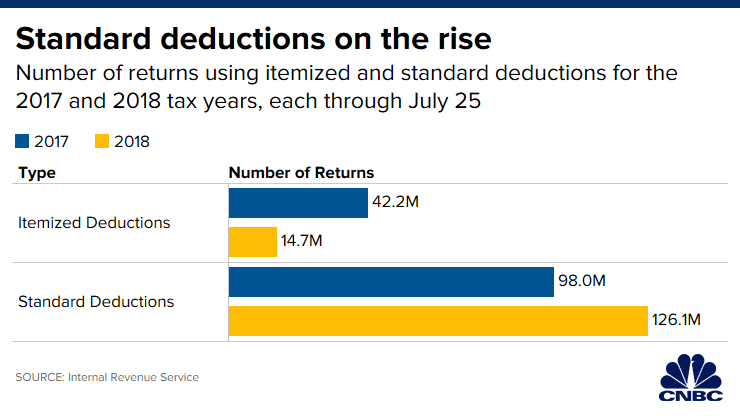
At the same time, the standard deduction for single filers went up to $12,000 in 2018 from $6,350 in 2017 (married filers with joint returns saw their standard deduction rise to $24,000 from $12,700).
The 2018 tax overhaul also curbed certain itemized deductions.
It also did away with personal exemptions, which once were $4,050 for yourself and each dependent in your household.
Due to the higher standard deduction, fewer people itemized on their returns.

More than 14.6 million individual income tax returns claimed itemized deductions, such as charitable giving write-offs and property taxes paid, during the 2018 tax year, according to IRS data through July 25, 2019 – the most recent figures available.
In comparison, 42.2 million returns filed for the 2017 tax year used itemized deductions, according to IRS data through July 25, 2018.
The right withholding is key
Maskot
Hefty refund checks suggest that you overpaid Uncle Sam during the prior year. It also means you took home less money.
“Sure, you can have a bigger refund, but you’re going to have less money in your pocket,” said Joseph Perry, national tax and business services leader at Marcum LLP.
Meanwhile, a balance due means you had too few taxes withheld from your pay — a situation some taxpayers found themselves in after the Treasury Department and IRS overhauled the tax withholding tables for the new law.
